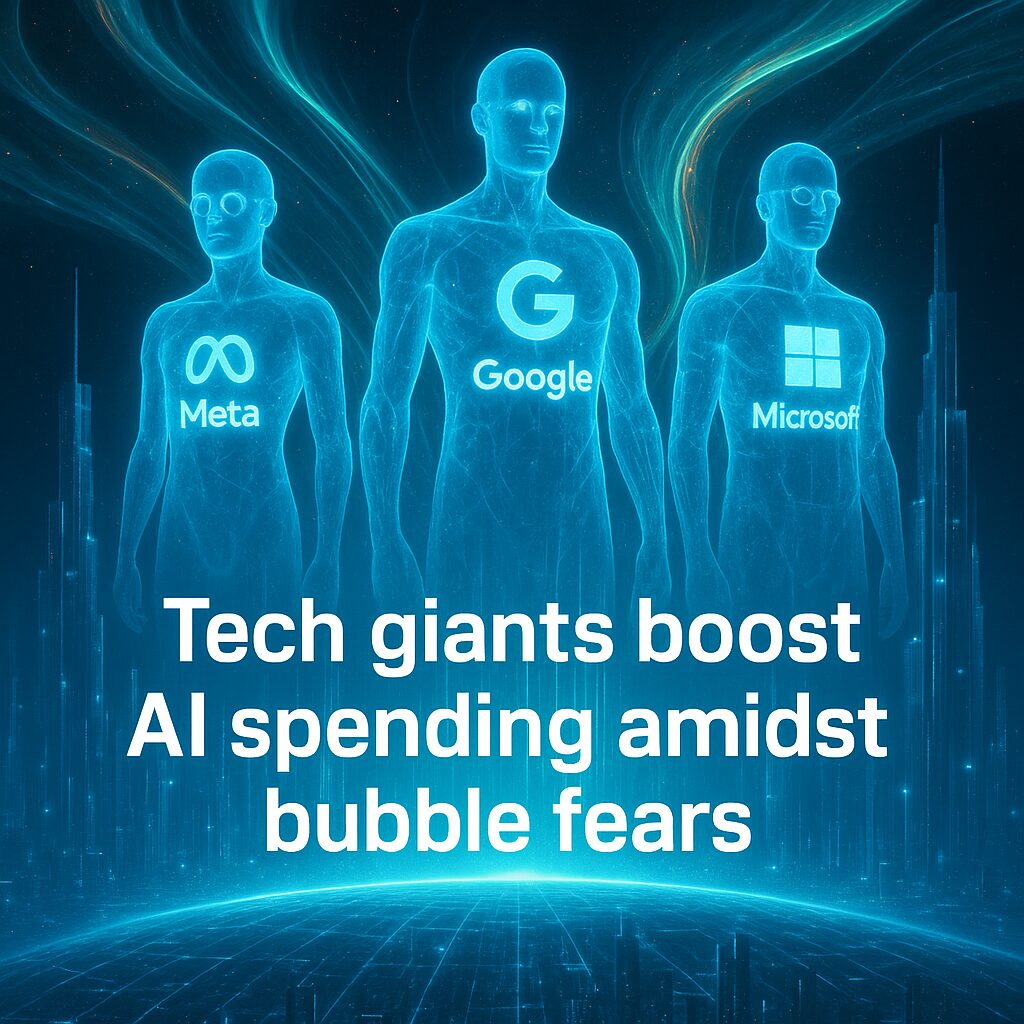
Meta, Google, and Microsoft Triple Down on AI Spending
# Riding the AI Wave: Are Microsoft, Google, and Meta Heading for a Boom or Bust?
In a world increasingly driven by artificial intelligence (AI), the tech giants stand at the precipice of a digital epoch that promises unprecedented possibilities. Microsoft, Google, and Meta have all recently reported record profits and an increased focus on AI infrastructure, but this tech renaissance arrives with the whispered warning of a potential AI market bubble.
## A Bold Bet on AI
Meta, Google, and Microsoft are collectively investing in the future, banking on the escalation and demand of AI technologies. The companies’ earnings reports reveal a significant uptick in capital expenditure for AI infrastructure. With Meta and Alphabet planning to increase their spending to ranges that could soar above $70 billion and $91 billion respectively, and Microsoft’s quarterly investments growing significantly, these companies are clearly making a statement: AI is not just a facet of their operations; it’s their new frontier.
An essential driving force behind these expenditures is AI’s current role and its latent potential. As Mark Zuckerberg pointed out in a conversation with analysts, preparing for the dawn of superintelligence demands a proactive approach. He emphasized, “I think that it’s the right strategy to aggressively front-load building capacity, so that way we’re prepared for the most optimistic cases.”
## The Mechanics of Transforming Ambition
This ambitious strategy isn’t simply about maintaining momentum; it’s about preempting and harnessing the hopeful promise of AI. Meta has notably increased its recruitment of AI experts, even offering packages worth hundreds of millions of dollars to capture top talent. And while job cuts might seem contradictory, such moves are purportedly aimed at honing efficiency within AI teams to better meet challenges head-on.
Google’s achievements are underscored by utility maximization. The tech behemoth touts profits from both traditional and AI-powered realms. Their focus on data centers and AI initiatives such as Google Cloud and Gemini reflects this commitment, with Gemini amassing 650 million monthly active users already—a significant uptick from the previous quarter.
Microsoft brings its own flair to the table. By ensuring their data centers are ‘fungible’ and by modernizing their infrastructure, they mirror a foresight that seems astute against the backdrop of this AI upsurge. CEO Satya Nadella explains, “It’s not like we buy one version of Nvidia and load up for all the gigawatts we have. Each year, you buy, you ride Moore’s law, you continually modernize and depreciate it, and you use software to grow efficiency.”
### Quotes from the Frontline
Crucially, these companies all echo a collective vision: AI isn’t just a fleeting fascination; it’s a bedrock upon which they intend to build a future replete with promise. As Zuckerberg pointedly observes, the industry stands on the precipice of harnessing AI for transformative growth: “There’s a range of timelines for when people think that we’re going to get superintelligence.”
## The Cautionary Tale of Bubbles Past
Yet, even amidst soaring revenues, the specter of a bubble looms large. Are these investments sustainable, or are they reminiscent of past speculative bubbles that promised much but delivered little? Analysts warn that the conspicuous, escalating spending could presage volatility akin to the dot-com bubble of the late 90s.
Nvidia’s announcement of a potential $100 billion dollar investment in OpenAI, contingent on building 10 gigawatts of AI data centers, only adds to this trepidation. It’s a staggering sum at the behest of unproven, though promising, technology. Microsoft’s own partnership with OpenAI, which includes a reported $13 billion investment, has led to net income hits and looming volatility warnings.
## Learning from the Past to Navigate the Future
From all these movements, what can businesses or individual investors glean?
1. **Strategic Patience**: While AI offers tremendous opportunity, it’s crucial to strategically assess when and where value will most likely be realized.
2. **Flexibility and Adaptation**: Microsoft’s focus on ‘fungible’ data centers highlights the importance of maintaining adaptable business models.
3. **Invest in Talent**: Amidst rapid technological evolution, having the right talent to navigate these transitions can offer a significant competitive edge.
Breaking this down, companies must strike a balance between ambition and prudence to fend off the potential economic fallout of errant spending. Learning from history—particularly acknowledging the signs of market saturation and overinvestment—is vital.
## What’s on the Horizon?
As these tech titans race towards an AI-dominated future, with substantial investments and record profits, the question remains: Is this the dawn of a new technological age or simply the calm before an economic storm? How these scenarios play out could very well hinge on external market realities as much as internal strategic execution.
For those watching closely, this pivotal moment spurs on a series of critical questions:
– Why do these companies believe AI investments hold the key to the future?
– How will they adapt if the market forecasts for AI do not align with reality?
The answers will inevitably shape not only the trajectory of technology but the broader business landscape and how industries adapt to or resist these rapid technological shifts in the years to come.