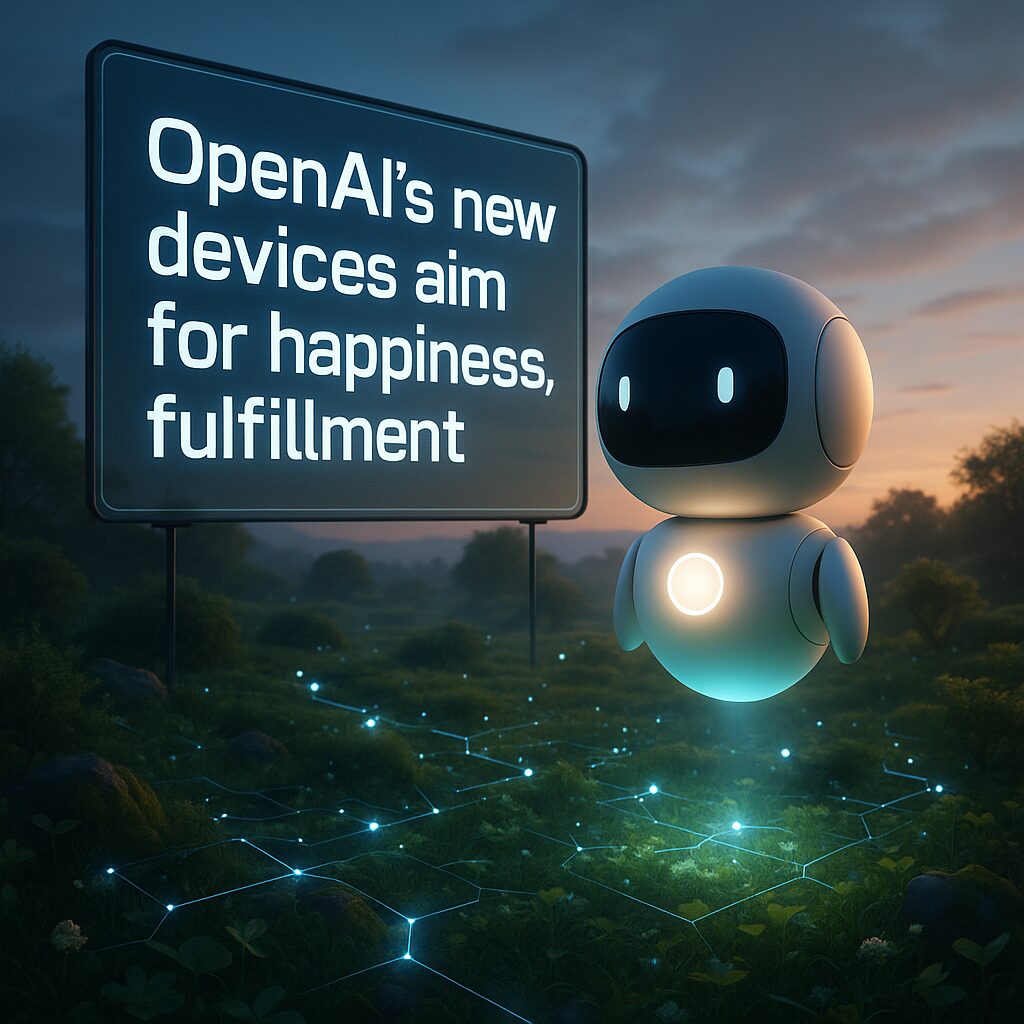
Jony Ive Says He Wants His OpenAI Devices to ‘Make Us Happy’
# New Frontiers for AI: Jony Ive and Sam Altman’s Vision Beyond Phones and Computers
In a digital era largely defined by incessant notifications and screens demanding our attention, rethinking our interaction with technology has become imperative. OpenAI’s CEO Sam Altman and renowned ex-Apple designer Jony Ive have embarked on an ambitious journey to provide a solution that may very well redefine this relationship. At OpenAI’s recent developer conference in San Francisco, Altman and Ive unveiled their partnership to create a new “family of devices” aimed not at productivity but at enhancing happiness and connection. Their vision is distinct: an AI-powered device that seeks to imbue our everyday experiences with joy, fulfillment, and a deeper sense of connection.
## Challenging the Status Quo: The Need for A New Vision
In the current landscape, phones and computers serve as our portals to the world. However, as Sam Altman puts it, “As great as phones and computers are, there’s something new to do.” The challenge lies in redefining what technology can do for us beyond serving work-related tasks. Altman acknowledges the complexity, stating, “Hardware is hard. Figuring out new computing form factors is hard.” Yet, this challenge is also where the potential for groundbreaking innovation lies.
Jony Ive, famous for his work on Apple’s iconic minimalistic and cohesive designs, sees this endeavor as an opportunity to transform our often complicated relationship with technology. “I don’t think we have an easy relationship with our technology at the moment,” observes Ive. Instead of treating AI as just another layer of technological complexity, there’s potential for it to transform our interactions with devices into something more positive and life-affirming.
## A Different Kind of Device
Altman and Ive envision devices that challenge conventional norms like phones or laptops. In a refreshing take, these proposed AI devices aim at social good. As Ive articulates, they should “make us happy, and fulfilled, and more peaceful, and less anxious, and less disconnected.” The aim is for a device that integrates seamlessly into life, potentially being screenless, relying on inputs from cameras and microphones, and being sensitive to a user’s surroundings and experiences.
– **Distinct Purpose**: No longer is efficiency the sole priority; the focus shifts to well-being.
– **Innovative Form**: A device that knows its user’s context without intrusive screens.
– **Connection-Oriented**: Fostering connections, instead of mere communication efficiency.
## Overcoming the Hurdles
Despite the promising vision, the path is fraught with challenges. Issues of technical feasibility have hampered progress, with speculation about the launch date being pushed as far as late 2026. The goal—creating technology that feels less like an external tool and more like a harmonious extension of ourselves—is an agenda not easily actionable.
Yet, their commitment is clear. With the acquisition of Ive’s design firm, LoveFrom, Altman and Ive have consolidated their resources and vision. As Ive reflects, “With the launch of ChatGPT, it felt like our purpose over the last six years became clear.” This collaboration allows LoveFrom’s foundational ideas to be explored and implemented with OpenAI’s cutting-edge AI capabilities.
## Learning from the Past: A Cautionary Tale
The venture is exhilarating, and Altman and Ive are not isolated in the pursuit of AI hardware excellence. Companies like Meta have attempted similar paths, although the Annals of learning are speckled with early failures. Meta’s AI smart glasses and their subsequent iterations underscore the commercial appetite but also the difficulty in achieving mass appeal and utility.
– **Humane Ai Pin**: Pulled from the market despite showing promise, indicating the unpredictable market reception.
– **Rabbit R1**: A representative of the cautious optimism that often surrounds nascent tech, further emphasized by WIRED’s frustrating user experiences.
These cautionary tales serve as critical comparisons, highlighting both the potential pitfalls and the valuable opportunities for learning within the realm of AI-powered devices.
## The Future and Human Connection
What lies ahead for AI in our daily lives is not simply about more technology; it’s about better lives enriched by thoughtful, empathetic design. The question of how AI can genuinely improve our well-being rather than just streamline processes is central to this endeavor. “The coolest piece of technology that the world will have ever seen,” as Altman imagines, is not merely about the tech itself but its impact on us as humans.
So, how might these future devices really enhance our personal happiness and collective connection? What if technology can make us our better selves, as per Ive’s hopeful vision? As the landscape of AI-powered devices evolves, the time may come to rethink our technology not just as tools but as companions in our daily journey—a possibility that’s gradually coming into view amid the collaborative efforts at OpenAI.
In contemplating these questions, perhaps it’s time to consider: When will we see a device that not only hears us but truly understands our need for balance between connectivity and peace?